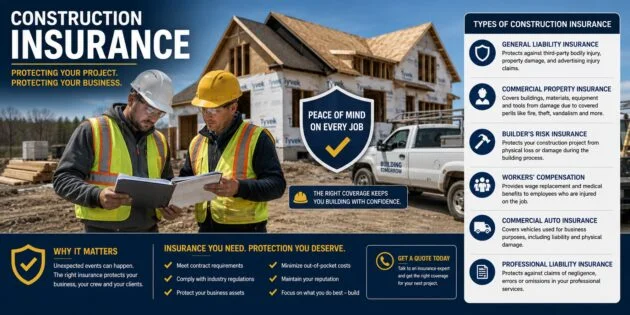
# Construction Insurance vs. General Liability Insurance: Key Differences for Contractors in 2026
Construction businesses face many risks every day. A contractor may damage a customer’s property, a worker may suffer an injury, expensive equipment may be stolen, or a construction project may experience unexpected delays. Even a small accident can create significant financial problems for a business. This is why choosing the right insurance coverage is an important part of running a successful construction company in the United States.
Two insurance terms that contractors frequently encounter are construction insurance and general liability insurance. Although these terms are closely related, they do not mean exactly the same thing. Construction insurance is a broad term that describes several types of insurance policies designed to protect construction businesses, contractors, builders, and construction projects. General liability insurance is a specific type of coverage that protects businesses against certain third-party claims involving bodily injury, property damage, and personal or advertising injury.
Understanding the difference between these two forms of insurance can help contractors make better financial decisions. Some contractors assume that purchasing general liability insurance automatically protects their entire business. Others believe that a construction insurance policy covers every possible accident or loss. Both assumptions can create expensive problems.
The right insurance strategy depends on the size of the construction business, the type of work performed, the number of employees, contract requirements, equipment ownership, and the risks associated with each project.
This guide explains construction insurance and general liability insurance, compares their coverage, discusses typical costs, and helps American contractors understand which policies they may need in 2026.
## 1. What Is Construction Insurance?
Construction insurance is a general term used for different insurance policies that protect construction companies, independent contractors, builders, subcontractors, and construction projects against financial losses.
Construction work involves several types of risks that are not always covered by a single insurance policy. A contractor may face liability claims, workplace injuries, equipment damage, theft, weather-related losses, or problems involving unfinished buildings.
Construction insurance helps businesses manage these risks by providing financial protection when covered events occur.
For example, imagine a residential contractor working on a new house in Texas. During construction, a severe storm damages part of the unfinished structure. The contractor may have to replace materials, repair damaged sections, and deal with unexpected expenses.
A suitable builder’s risk policy may help cover certain physical losses to the building and construction materials, depending on the policy terms and exclusions.
In another situation, a subcontractor accidentally damages a customer’s property while installing plumbing equipment. General liability insurance may help cover the resulting third-party claim if the incident is covered.
These examples demonstrate why construction businesses often need several insurance policies rather than relying on one basic plan.
### Common Types of Construction Insurance
Construction insurance can include several different forms of coverage.
General Liability Insurance: Helps protect contractors against covered third-party bodily injury, property damage, and personal and advertising injury claims.
Workers’ Compensation Insurance: Provides benefits for employees who experience qualifying work-related injuries or illnesses, subject to state law.
Builder’s Risk Insurance: Helps protect buildings and construction materials against certain physical losses during construction.
Commercial Auto Insurance: Covers qualifying business-related vehicle risks, including certain liability and physical damage losses.
Contractor’s Equipment Insurance: Helps protect tools, machinery, and equipment against covered damage or theft.
Professional Liability Insurance: May protect contractors, architects, engineers, and design professionals against certain claims involving professional services or errors.
Commercial Property Insurance: Helps protect business buildings, offices, inventory, and other covered property.
Umbrella Insurance: Provides additional liability limits above certain underlying insurance policies when the umbrella policy conditions are satisfied.
Not every construction company needs every policy. A small painting contractor may require a different insurance arrangement from a large commercial construction company managing multiple projects.
## 2. What Is General Liability Insurance?
General liability insurance is a business insurance policy that helps protect companies against certain claims made by third parties.
For construction contractors, this coverage is particularly important because their daily activities can affect customers, visitors, neighboring properties, and other people at a job site.
A general liability policy typically addresses three major categories of coverage:
– Bodily injury to third parties.
– Property damage to third parties.
– Personal and advertising injury.
The policy may pay covered legal defense expenses, settlements, or judgments, subject to its terms, exclusions, and coverage limits.
Consider a contractor installing new flooring in a customer’s home. During the project, a worker accidentally drops a heavy tool and damages an expensive kitchen appliance.
The homeowner may demand compensation for the damage. If the contractor has an applicable general liability policy, the insurer may investigate the claim and provide coverage if the incident falls within the policy.
However, general liability insurance does not automatically cover every accident involving the contractor or the contractor’s employees.
For example, an employee who suffers an injury while performing construction work generally requires workers’ compensation protection rather than relying on the employer’s general liability policy.
### What Does General Liability Insurance Cover?
The exact coverage depends on the policy, but common protection includes the following.
Third-Party Bodily Injury
This coverage may apply when someone other than an employee suffers an injury connected to the contractor’s business operations.
For example, a visitor walks through a construction area, trips over a material left on the ground, and suffers an injury.
The injured person may file a claim against the contractor. General liability insurance may cover eligible medical expenses, legal defense costs, or other covered damages.
Third-Party Property Damage
Construction activities can accidentally damage buildings, vehicles, furniture, landscaping, or neighboring properties.
For example, a contractor uses heavy machinery near a customer’s property and accidentally damages an exterior wall.
General liability insurance may help cover the resulting third-party property damage claim.
Personal and Advertising Injury
This coverage can address certain nonphysical injuries, such as covered claims involving libel, slander, or specific advertising-related offenses.
A contractor could face a claim involving an allegedly defamatory statement made in advertising material.
Whether the policy responds depends on its definitions, exclusions, and circumstances.
Legal Defense Costs
Defending a liability claim can be expensive even when a contractor believes the allegations are incorrect.
General liability insurance may provide legal defense for covered claims, subject to policy conditions.
This protection can be valuable because legal expenses may become a major financial burden for small construction businesses.
## 3. Construction Insurance vs. General Liability Insurance: Main Differences
The most important difference is that construction insurance is a broad category, while general liability insurance is one specific type of insurance.
Construction insurance can protect different parts of a construction business, including employees, buildings, equipment, vehicles, and third-party liability exposures.
General liability insurance focuses primarily on qualifying third-party injury, property damage, and personal and advertising injury claims.
The following comparison makes the differences easier to understand.
| Feature | Construction Insurance | General Liability Insurance |
| ——————– | ——————————————— | —————————————————- |
| Meaning | Broad category of insurance policies | Specific liability policy |
| Main purpose | Protects different construction risks | Protects against covered third-party claims |
| Property damage | Depends on selected policies | Covers qualifying third-party damage |
| Employee injuries | Workers’ compensation may apply | Generally excluded |
| Equipment protection | Available through suitable coverage | Generally not covered |
| Building protection | Builder’s risk or property coverage may apply | Not intended to insure the contractor’s own building |
| Legal liability | Available through liability policies | Main purpose of the policy |
| Vehicle protection | Commercial auto coverage may apply | Generally excluded |
| Project protection | Builder’s risk and other project policies | Limited to applicable liability exposures |
A contractor should not compare these two terms as if they were completely separate alternatives. General liability insurance can actually be one component of a broader construction insurance program.
## 4. Why Contractors Need Construction Insurance
Construction businesses operate in an environment where accidents, delays, and unexpected expenses can happen without warning.
Even experienced contractors cannot eliminate every possible risk. A well-organized construction company may still experience property damage, employee injuries, equipment theft, or liability claims.
Insurance helps contractors prepare for these situations.
### Financial Protection
One of the biggest reasons contractors purchase insurance is to protect their business finances.
A serious accident can create expenses involving repairs, legal services, medical benefits, replacement equipment, and project delays.
Without appropriate insurance, a small business may have to pay these expenses directly.
For an independent contractor with limited savings, one major claim could create long-term financial difficulties.
### Meeting Contract Requirements
Many property owners, general contractors, and commercial clients require contractors to provide proof of insurance before starting work.
A construction contract may require specific general liability limits, workers’ compensation coverage, commercial auto insurance, or additional insured status.
Some projects also require builder’s risk coverage or other specialized policies.
Contractors who cannot meet these requirements may lose opportunities to work on valuable projects.
### Protecting Construction Equipment
Construction equipment can represent a significant investment.
Contractors may own drills, generators, compressors, excavators, trailers, scaffolding, and other expensive tools.
If equipment is stolen or damaged, replacing it can be difficult.
An appropriate contractor’s equipment policy may help cover certain losses, depending on the insured property, location, and policy conditions.
### Protecting Business Reputation
Insurance can also help a contractor maintain professional relationships.
Clients are generally more comfortable hiring businesses that demonstrate financial responsibility and carry appropriate insurance.
Being able to provide an insurance certificate can help contractors qualify for commercial contracts and larger projects.
However, an insurance certificate is evidence of certain coverage information, not a guarantee that every possible claim is covered.
## 5. Why General Liability Insurance Is Important for Contractors
General liability insurance is one of the most commonly requested forms of business insurance in the construction industry.
Contractors regularly work around customers, employees of other businesses, visitors, property owners, and neighboring buildings.
This creates opportunities for accidents that may result in third-party claims.
### Protection Against Accidental Property Damage
A contractor may accidentally damage property while performing ordinary construction activities.
For example, a roofing contractor may drop a piece of equipment and damage a customer’s vehicle.
A plumbing contractor may accidentally damage part of a commercial building while completing an installation.
A general liability policy may help cover qualifying third-party property damage claims.
### Protection Against Injury Claims
Construction sites can be dangerous places.
Although contractors use safety equipment and follow workplace procedures, visitors and members of the public may still experience accidents.
A customer visiting a renovation site might slip on an unsafe walkway and suffer an injury.
The contractor could face a liability claim depending on the circumstances.
General liability insurance may help cover qualifying claims and associated defense expenses.
### Supporting Business Contracts
Many customers require contractors to maintain general liability coverage before work begins.
Commercial clients may specify minimum policy limits and require proof of insurance.
Some contracts require an owner, property manager, or general contractor to be listed as an additional insured for specified liability exposures.
Contractors should review these requirements carefully before purchasing a policy.
## 6. What Construction Insurance Does Not Automatically Cover
The term construction insurance can create confusion because it describes multiple products rather than one universal policy.
A contractor should understand that purchasing one insurance policy does not necessarily protect every business activity.
For example, general liability insurance generally does not cover the contractor’s own equipment simply because the equipment was damaged at a construction site.
Likewise, builder’s risk insurance is not a replacement for general liability coverage.
Common coverage gaps include:
Employee Injuries: Workers’ compensation insurance generally addresses qualifying employee work-related injuries and illnesses.
Professional Mistakes: Professional liability insurance may be needed for claims involving design errors, consulting services, or professional advice.
Commercial Vehicles: Commercial auto insurance may be necessary for vehicles used in business operations.
Equipment Theft: Contractor’s equipment coverage may be required to protect eligible tools and machinery.
Damage to the Contractor’s Own Work: General liability policies may contain exclusions involving the insured’s own work or product. Some resulting damage may be covered depending on the policy and circumstances, but contractors should not assume all faulty workmanship is insured.
Flood and Earthquake Damage: Standard property policies may exclude certain natural disasters or provide limited coverage. Separate coverage or endorsements may be necessary.
Understanding these exclusions is essential when comparing insurance policies.
## 7. How Much Does Construction Insurance Cost in the USA in 2026?
Construction insurance costs vary significantly depending on the type of contractor, location, business revenue, payroll, number of employees, project size, and claims history.
There is no single price that applies to every construction company.
A small residential contractor may pay considerably less than a large commercial construction business with several employees and expensive equipment.
The cost also depends on which policies are included in the insurance program.
### General Liability Insurance Costs
General liability insurance premiums are influenced by several factors:
– Type of construction work.
– Annual business revenue.
– Number of employees.
– Previous insurance claims.
– Location of operations.
– Coverage limits.
– Deductibles and policy endorsements.
A contractor performing relatively low-risk interior finishing work may receive a different quote from a roofing contractor working on large commercial buildings.
Roofing, structural work, demolition, and certain high-risk construction activities may create higher insurance costs.
### Workers’ Compensation Insurance Costs
Workers’ compensation premiums are often influenced by employee payroll and job classifications.
Different construction activities have different levels of risk.
For example, office employees and construction laborers generally do not have the same exposure to workplace injuries.
State laws and rating systems also affect workers’ compensation costs.
### Builder’s Risk Insurance Costs
Builder’s risk premiums depend on the insured construction value, project duration, construction type, location, protection measures, and coverage selected.
A large commercial building project may require a substantially different policy from a small residential renovation.
### Contractor’s Equipment Insurance Costs
Equipment insurance pricing can depend on:
– Total equipment value.
– Type of machinery.
– Equipment age.
– Storage arrangements.
– Theft prevention measures.
– Claims history.
– Coverage territory.
Contractors with expensive mobile equipment may need specialized coverage designed for equipment used at different job sites.
### How to Get an Accurate Insurance Quote
Contractors should compare quotes using the same coverage requirements.
A cheaper policy may have lower limits, more exclusions, or a higher deductible.
Before accepting a quote, review the following:
Construction Insurance
1. Coverage limits.
2. Deductible amounts.
3. Covered business activities.
4. Exclusions and limitations.
5. Additional insured requirements.
6. Policy endorsements.
7. Claims handling arrangements.
8. Total annual premium.
Comparing the actual policy terms is more useful than choosing an insurance company based only on price.
## 8. Construction Insurance vs. General Liability Insurance Costs
The cost comparison can be confusing because construction insurance is not one individual policy.
A construction insurance program may combine several policies, each with its own premium.
General liability insurance is only one part of that potential arrangement.
For example, a small contractor may purchase general liability insurance as the primary policy and add workers’ compensation and commercial auto insurance when required.
A larger construction company may need a more extensive program involving builder’s risk, umbrella liability, equipment insurance, and professional liability.
The total cost of the larger program will generally be higher because it addresses more risks.
However, contractors should not automatically purchase every available insurance product.
The goal should be to identify realistic business exposures and select coverage that addresses those risks without paying for unnecessary protection.
## 9. Which Contractors Need General Liability Insurance?
General liability insurance can be useful for almost every type of construction business, although exact insurance requirements vary by contract, state, and business activity.
Different contractors face different risks.
### General Contractors
General contractors coordinate construction projects and manage subcontractors, suppliers, workers, and customers.
Their operations can create several liability exposures.
For example, a general contractor may face a claim involving property damage caused during renovation work.
General liability coverage may help protect against qualifying third-party claims.
### Roofing Contractors
Roofing businesses work at elevated heights and handle materials that can accidentally fall or damage surrounding property.
A roofing contractor may face claims involving damaged vehicles, broken windows, or injuries to third parties.
Roofing insurance requirements and premiums can be different from those for lower-risk trades.
### Electrical Contractors
Electricians work with wiring, electrical panels, and other potentially hazardous systems.
Accidents involving electrical installations can create property damage or injury claims.
General liability insurance may address certain third-party claims, while professional liability or other coverage may be appropriate for specific services.
### Plumbing Contractors
Plumbing contractors work with pipes, water systems, drainage, and fixtures.
An installation mistake or accidental damage during work may lead to property damage claims.
General liability coverage can help address certain third-party claims.
### Painting Contractors
Painting contractors may accidentally damage flooring, furniture, windows, or other customer property.
They may also face third-party injury claims involving visitors or customers.
General liability insurance is commonly considered an important part of their business protection.
### Concrete Contractors
Concrete contractors work with heavy machinery, construction materials, foundations, driveways, and commercial structures.
Their operations may create risks involving neighboring properties, vehicles, and third parties.
Appropriate liability and equipment insurance can help manage these exposures.
## 10. Is General Liability Insurance Enough for a Construction Business?
For some small contractors, general liability insurance may address an important part of their insurance needs.
However, it is rarely sensible to assume that this policy alone protects an entire construction business.
General liability insurance focuses on qualifying third-party claims.
It does not generally replace coverage for employee injuries, commercial vehicles, buildings under construction, or the contractor’s own tools and equipment.
Consider a small construction company with five employees.
The company may need general liability coverage for third-party claims, workers’ compensation coverage under applicable state requirements, and commercial auto coverage for business vehicles.
If the company also owns expensive equipment, it may benefit from contractor’s equipment insurance.
If it works on a building project, the project may require builder’s risk coverage.
The appropriate combination depends on the company’s activities and contractual obligations.
Before deciding that one policy is sufficient, contractors should review their business operations with a licensed insurance professional.
## 11. What Is Builder’s Risk Insurance?
Builder’s risk insurance is a specialized form of property insurance designed to protect buildings and certain materials during construction.
It is particularly relevant for property owners, developers, general contractors, and other parties with an insurable interest in a construction project.
A building under construction is exposed to several potential risks.
Severe weather, fire, vandalism, and certain accidental physical losses may damage the project.
Builder’s risk coverage may help pay for covered physical damage to the insured property.
### What Does Builder’s Risk Insurance Cover?
Depending on the policy, coverage may include:
– Buildings under construction.
– Certain construction materials.
– Materials stored at specified locations.
– Certain temporary structures.
– Some materials in transit, if included.
– Certain covered physical losses caused by insured events.
Coverage can vary substantially between insurers.
Some policies contain restrictions involving theft, water damage, faulty workmanship, testing, or other construction-related exposures.
### Who Needs Builder’s Risk Insurance?
Builder’s risk insurance may be appropriate for:
– Residential builders.
– Commercial developers.
– General contractors.
– Property owners.
– Real estate investors.
– Construction project owners.
The party responsible for purchasing the policy should be identified in the construction contract.
Contractors should also verify that the correct parties and project interests are properly insured.
## 12. Workers’ Compensation vs. General Liability Insurance
Workers’ compensation and general liability insurance are different policies that serve different purposes.
Workers’ compensation generally provides statutory benefits for employees who experience qualifying work-related injuries or illnesses.
General liability insurance primarily addresses qualifying claims brought by third parties.
For example, suppose a construction employee falls while installing a roof and suffers a serious injury.
Workers’ compensation may provide benefits for the employee, subject to applicable law and policy terms.
Now imagine a customer visiting the property falls over construction materials and suffers an injury.
The contractor may face a third-party liability claim that could fall under general liability insurance.
This distinction is important because contractors sometimes mistakenly believe that general liability insurance covers all injuries occurring at a construction site.
It does not.
### Why Both Policies May Be Necessary
A construction company may have employees working on multiple projects.
Workers’ compensation helps address employee injury exposures, while general liability insurance addresses certain claims involving other people.
Together, these policies can provide different types of financial protection.
Workers’ compensation requirements vary by state, and some states have specific rules for construction businesses and subcontractors.
Contractors should confirm their obligations with the relevant state agency or a qualified insurance professional.
## 13. Commercial Auto Insurance for Construction Businesses
Many construction businesses use trucks, vans, trailers, and specialized vehicles to transport employees, tools, and materials.
Personal auto insurance does not automatically provide adequate protection for every business-related vehicle exposure.
Commercial auto insurance is designed for eligible vehicles used in business operations.
Depending on the policy, coverage may include:
– Bodily injury liability.
– Property damage liability.
– Collision coverage.
– Comprehensive coverage.
– Certain uninsured or under insured motorist protection.
A contractor who regularly transports construction materials or operates work vehicles should review commercial auto requirements.
For example, a company using pickup trucks to transport equipment between job sites may need commercial vehicle coverage.
The appropriate policy depends on vehicle ownership, use, state requirements, and the insurance company’s underwriting rules.
## 14. Professional Liability Insurance for Contractors
Professional liability insurance is another type of coverage that may be important for construction businesses offering design, consulting, engineering, or other professional services.
General liability insurance does not automatically cover every claim involving professional mistakes.
For example, an engineering consultant may provide technical recommendations that allegedly cause financial losses for a client.
A professional liability policy may help address certain claims involving errors, omissions, or negligent professional services.
Coverage depends on the professional services insured, policy wording, and exclusions.
Contractors who provide design-build services should pay particular attention to this issue.
They may have both construction-related liability exposures and professional service exposures.
## 15. How to Choose the Right Construction Insurance Company
Selecting an insurance provider is an important decision because coverage quality matters when a serious claim occurs.
Contractors should evaluate insurers based on more than advertising, price, or brand recognition.
### Financial Strength
Insurance companies need the financial ability to meet covered claims.
Contractors can review independent financial strength ratings from organizations such as AM Best.
A strong financial rating can provide useful information about an insurer’s financial condition, although it does not guarantee a particular claim outcome.
### Construction Industry Experience
Some insurers have more experience with construction businesses than others.
An insurer familiar with contractors may better understand different trades, project requirements, equipment risks, and construction contracts.
### Coverage Options
Contractors should check whether the insurer offers the specific policies they need.
For example, a business that needs general liability, workers’ compensation, commercial auto, and equipment insurance may prefer working with an insurer or broker that can coordinate these products.
### Claims Service
A policy is only useful when a covered loss occurs.
Contractors should consider how claims are reported, how quickly insurers communicate, and what support is available during the claims process.
### Policy Exclusions
Exclusions can make a significant difference in the actual value of insurance coverage.
Contractors should carefully review exclusions involving roofing, subcontractors, residential work, height restrictions, completed operations, and other relevant activities.
An inexpensive policy may not provide the protection required by a particular construction business.
## 16. Popular Construction Insurance Companies in the USA
Several insurance companies and insurance providers serve American contractors.
Availability, policy terms, underwriting requirements, and prices vary by state and business type.
The following companies are worth researching when comparing coverage.
### NEXT Insurance
NEXT Insurance focuses on small businesses and independent professionals, including certain contractors.
Its online platform allows eligible businesses to explore coverage options and obtain quotes.
Contractors should verify whether their specific trade and project requirements are eligible.
Official website: [https://www.nextinsurance.com/](https://www.nextinsurance.com/?utm_source=chatgpt.com)
### His cox
His cox offers business insurance products for eligible small businesses and professional service providers.
Some contractors may find its general liability and professional liability products relevant, depending on the nature of their operations.
Policy availability and coverage vary.
Official website: [https://www.hiscox.com/](https://www.hiscox.com/?utm_source=chatgpt.com)
### The Hartford
The Hartford provides several business insurance products, including coverage options for eligible small and medium-sized businesses.
Contractors can investigate its general liability, workers’ compensation, commercial auto, and property insurance offerings.
Official website: [https://www.thehartford.com/](https://www.thehartford.com/?utm_source=chatgpt.com)
### Nationwide
Nationwide offers business insurance products and serves various commercial industries.
Construction businesses can investigate available liability, property, auto, and other commercial coverage options.
Official website: [https://www.nationwide.com/](https://www.nationwide.com/?utm_source=chatgpt.com)
### Travelers
Travelers provides commercial insurance products for businesses, including construction-related operations.
Its commercial insurance offerings may be relevant to contractors managing larger or more complex projects.
Official website: [https://www.travelers.com/](https://www.travelers.com/?utm_source=chatgpt.com)
### Progressive Commercial
Progressive Commercial is particularly relevant for contractors looking for commercial vehicle insurance.
Depending on eligibility and location, businesses can explore coverage for trucks, vans, and other commercial vehicles.
Official website: [https://www.progressivecommercial.com/](https://www.progressivecommercial.com/?utm_source=chatgpt.com)
### How to Compare These Providers
Contractors should request quotes based on the same business information and coverage requirements.
A useful comparison should include:
1. General liability limits.
2. Workers’ compensation availability.
3. Commercial auto options.
4. Equipment coverage.
5. Builder’s risk availability.
6. Deductibles.
7. Policy exclusions.
8. Additional insured options.
9. Financial strength.
10. Customer and claims service.
Not every company offers every type of construction insurance directly in every state.
An independent commercial insurance broker may help contractors compare products from multiple insurers.
## 17. What Insurance Limits Should Contractors Choose?
Insurance limits determine the maximum amount an insurer may pay for covered claims under the applicable policy terms.
Choosing appropriate limits is important because a serious construction accident can result in significant financial damages.
Many commercial clients request general liability limits of $1 million per occurrence and $2 million aggregate.
These are common contract requirements, not universal legal minimums.
Some larger construction projects require higher limits, umbrella coverage, or additional insurance provisions.
### Understanding Per-Occurrence Limits
A per-occurrence limit is generally the maximum amount available for a covered occurrence under the policy.
For example, a policy with a $1 million per-occurrence limit may provide up to $1 million for a qualifying occurrence, subject to the policy terms.
### Understanding Aggregate Limits
An aggregate limit is the maximum amount available for covered claims during the applicable policy period, subject to how the policy defines and applies the limit.
For example, a policy may have a $2 million general aggregate limit.
The contractor should understand whether the aggregate is shared across projects or whether separate project aggregate limits apply.
### When Is Umbrella Insurance Useful?
Umbrella insurance may provide additional liability limits above certain underlying policies.
A contractor managing large commercial projects may face higher contractual insurance requirements.
An umbrella policy may help increase available liability protection.
However, umbrella policies have their own conditions, exclusions, and underlying insurance requirements.
Contractors should verify that the umbrella coverage actually applies to the risks they want to protect.
## 18. How Construction Insurance Requirements Vary by State
Construction insurance rules are not identical across the United States.
Each state has its own insurance regulations, workers’ compensation requirements, contractor licensing rules, and other business obligations.
Some states require workers’ compensation coverage for businesses with employees, while others have different thresholds and exceptions.
Construction businesses may also face special rules involving independent contractors and subcontractors.
For example, a contractor may hire an independent subcontractor to complete electrical or plumbing work.
The general contractor should not automatically assume that the subcontractor has adequate insurance.
It is important to request certificates of insurance and verify relevant coverage.
Some contracts may require subcontractors to provide additional insured endorsements.
Requirements can also differ for residential and commercial projects.
Before beginning work in a new state, contractors should review local licensing and insurance requirements.
## 19. Common Construction Insurance Mistakes to Avoid
Even businesses with insurance can experience serious financial problems if their policies do not match their actual operations.
The following mistakes are worth avoiding.
### Buying Insurance Based Only on Price
Choosing the cheapest insurance quote may seem attractive, especially for a new contractor.
However, a low premium may come with limited coverage, restrictive endorsements, or important exclusions.
Contractors should compare the complete policy rather than focusing only on the annual payment.
### Not Updating Insurance Information
A construction business may grow over time.
It may hire employees, purchase equipment, increase revenue, expand into new states, or start accepting larger projects.
Insurance policies should be reviewed when significant business changes occur.
Failing to update information can create coverage problems.
### Assuming Subcontractors Are Automatically Covered
General contractors sometimes assume that their own insurance automatically protects every subcontractor.
That is not always true.
Subcontractors should have appropriate insurance for their own operations, and contractual insurance requirements should be reviewed carefully.
### Ignoring Completed Operations Coverage
Construction work can create claims after a project has been completed.
For example, a customer may report property damage several months after a contractor finishes a renovation.
Products-completed operations coverage is an important part of many general liability policies.
Contractors should understand how this coverage applies to their work and whether any exclusions are relevant.
### Not Reviewing Policy Exclusions
Every insurance policy contains conditions and exclusions.
Contractors should pay particular attention to exclusions involving:
– Certain roofing operations.
– Faulty workmanship.
– Employee injuries.
– Professional services.
– Pollution.
– Contractual liability.
– Damage to the insured’s own work.
– Specific types of subcontracted work.
Understanding exclusions before a claim occurs is much better than discovering them during a dispute.
### Failing to Maintain Accurate Records
Construction businesses should maintain records of contracts, invoices, insurance certificates, employee information, equipment purchases, and safety procedures.
Good documentation can make insurance administration and claims reporting easier.
## 20. How to Reduce Construction Insurance Costs
Insurance can become a significant operating expense, particularly for businesses with employees, vehicles, expensive equipment, and multiple construction projects.
However, contractors can take practical steps to manage premiums.
### Improve Workplace Safety
A strong safety program can help reduce workplace accidents and improve risk management.
Contractors should provide appropriate training, maintain equipment, use protective equipment, and follow relevant safety regulations.
Although safety improvements do not guarantee lower premiums, they can help businesses manage risks and may improve their insurance profile.
### Compare Multiple Quotes
Contractors should compare offers from several insurers or qualified commercial insurance brokers.
Comparing multiple quotes can help identify competitive pricing and better coverage options.
### Maintain a Good Claims History
Frequent insurance claims can affect underwriting decisions and premiums.
Businesses should take reasonable steps to prevent avoidable accidents and address safety problems.
However, contractors should never avoid reporting a claim simply to protect their insurance history when reporting is required by the policy.
### Review Deductibles
Some insurance products allow businesses to choose different deductible amounts.
A higher deductible may reduce the premium in certain cases, but it also means the business must pay more out of pocket for a covered loss.
Contractors should select deductibles that match their financial ability.
### Bundle Suitable Policies
Some insurers offer package arrangements or pricing advantages when a business purchases multiple policies.
For example, a contractor may be able to obtain general liability and commercial property insurance from the same provider.
However, bundling is not always cheaper.
Compare the total price and coverage before making a decision.
### Work With an Experienced Insurance Broker
A commercial insurance broker familiar with construction businesses can help identify potential coverage gaps and explain complicated policy terms.
The broker may also help contractors compare different insurance providers.
## 21. Construction Insurance for Independent Contractors
Independent contractors often have different insurance needs from larger construction companies.
A self-employed electrician, carpenter, painter, or handyman may operate without full-time employees.
However, working independently does not eliminate third-party liability risks.
An independent contractor could accidentally damage a customer’s property or face an injury-related claim from a visitor.
General liability insurance may be useful in these situations.
Depending on the type of work, the contractor may also need:
– Tools and equipment coverage.
– Commercial auto insurance.
– Professional liability insurance.
– Workers’ compensation or appropriate alternative arrangements where required.
– Additional coverage required by customer contracts.
Independent contractors should also understand that using subcontractors or hiring employees may change their insurance obligations.
Insurance needs should be reviewed whenever business operations change.
## 22. Construction Insurance for Small Businesses
Small construction businesses often operate with limited financial resources.
A major uninsured loss could affect cash flow, payroll, equipment replacement, and future projects.
For this reason, selecting appropriate insurance coverage is particularly important.
A small residential construction business may consider a combination of:
General Liability Insurance: For qualifying third-party injury and property damage claims.
Workers’ Compensation Insurance: When required by applicable law and business circumstances.
Commercial Auto Insurance: For eligible business vehicles.
Contractor’s Equipment Insurance: For valuable tools and machinery.
Builder’s Risk Insurance: When the contractor or another party has responsibility for insuring a project.
The exact arrangement depends on the business model.
A small painting company may need fewer specialized policies than a company building commercial properties.
The best approach is to identify the company’s actual risks and compare suitable coverage options.
## 23. How to Get Construction Insurance in the USA
Purchasing construction insurance does not need to be unnecessarily complicated.
Contractors can make the process easier by preparing basic business information before requesting quotes.
### Step 1: Identify Your Business Activities
Start by describing exactly what your business does.
Insurance companies may classify roofing, electrical work, plumbing, concrete installation, remodeling, and general contracting differently.
Accurate information helps insurers evaluate risk.
### Step 2: Estimate Annual Revenue and Payroll
Insurers commonly use business revenue and payroll information when evaluating certain policies.
Contractors should provide realistic estimates rather than guessing.
### Step 3: Identify Your Insurance Requirements
Review customer contracts, licensing rules, and project requirements.
Determine whether you need general liability, workers’ compensation, commercial auto, builder’s risk, or other specialized coverage.
### Step 4: Request Multiple Quotes
Contact several insurance companies or commercial insurance brokers.
Provide the same information and coverage requirements to make comparisons more meaningful.
### Step 5: Review Policy Documents
Do not purchase coverage without understanding the policy’s major conditions and exclusions.
Ask questions about any unclear language.
### Step 6: Purchase Appropriate Coverage
Once you have compared the options, select the insurance arrangement that meets your business requirements and financial situation.
Keep copies of policy documents and certificates of insurance.
### Step 7: Review Coverage Regularly
Review your insurance program at renewal and whenever your business changes significantly.
A policy that worked for a small contractor may not be sufficient after the company begins managing larger projects.
## 24. Real-Life Examples: Understanding the Difference
The following examples show how construction insurance and general liability insurance may respond to different situations.
### Example 1: A Contractor Damages a Customer’s Property
A remodeling contractor is installing new kitchen cabinets.
During the installation, a worker accidentally damages the customer’s expensive counter top.
The customer requests payment for the damage.
General liability insurance may cover the third-party property damage claim, depending on the circumstances and policy exclusions.
### Example 2: A Worker Suffers an Injury
A construction employee falls from a ladder while working on a residential property.
The employee requires medical treatment and misses several weeks of work.
Workers’ compensation insurance may provide applicable medical and wage benefits under state law.
General liability insurance is generally not a substitute for workers’ compensation.
### Example 3: A Construction Site Is Damaged by Fire
A partially completed building experiences a fire during construction.
The building materials and unfinished structure suffer physical damage.
An applicable builder’s risk policy may cover certain losses, subject to the policy terms and exclusions.
General liability insurance is not designed to insure the contractor’s own construction project against ordinary property losses.
### Example 4: Construction Equipment Is Stolen
A contractor leaves a generator and other tools at a job site overnight.
The equipment is stolen.
A suitable contractor’s equipment policy may help cover the loss, depending on the policy conditions, security requirements, and covered property.
General liability insurance generally does not cover stolen business equipment.
### Example 5: A Visitor Is Injured at a Construction Site
A customer visits a property where a contractor is performing renovation work.
The visitor trips over construction materials and suffers an injury.
The contractor may face a third-party bodily injury claim.
General liability insurance may provide coverage for an eligible claim.
These examples demonstrate why different insurance products serve different purposes.
## 25. Frequently Asked Questions
### 1. Is construction insurance the same as general liability insurance?
No. Construction insurance is a broad term for several insurance products designed to protect construction businesses and projects. General liability insurance is one specific policy that addresses qualifying third-party injury, property damage, and personal and advertising injury claims.
### 2. Do contractors need general liability insurance?
General liability insurance is commonly required by customers, general contractors, and commercial project owners. Even when it is not legally required, it can help protect contractors against certain third-party claims.
### 3. Does general liability insurance cover construction workers?
Generally, no. Employee work-related injuries are usually addressed through workers’ compensation insurance, subject to applicable laws and policy terms.
### 4. Does construction insurance cover equipment theft?
It can, if the contractor purchases appropriate equipment coverage and the theft falls within the policy terms.
General liability insurance generally does not cover the contractor’s own stolen tools and machinery.
### 5. How much general liability insurance does a contractor need?
The appropriate limit depends on the contractor’s operations, contracts, project size, and risk exposure.
Some commercial contracts commonly request $1 million per occurrence and $2 million aggregate, but larger projects may require higher limits.
### 6. Is builder’s risk insurance included in general liability insurance?
No. Builder’s risk and general liability insurance serve different purposes.
Builder’s risk generally addresses certain physical losses to buildings and materials during construction, while general liability addresses covered third-party claims.
### 7. Can a small contractor buy construction insurance?
Yes. Small contractors and independent professionals can explore insurance options designed for their specific trades and business activities.
### 8. Do subcontractors need their own insurance?
Many general contractors require subcontractors to maintain their own liability and other applicable insurance.
The exact requirements should be stated in the construction contract.
### 9. Does general liability insurance cover faulty workmanship?
Not necessarily. General liability policies commonly contain exclusions involving faulty workmanship or damage to the insured’s own work.
However, certain resulting damage may receive coverage depending on the circumstances and policy language.
Contractors should review the policy carefully.
### 10. What is the difference between contractor insurance and business insurance?
Contractor insurance generally refers to insurance products designed for construction professionals and their specific risks.
Business insurance is a broader term that can apply to companies across many industries.
### 11. Can a contractor work without general liability insurance?
Legal requirements vary by state, licensing category, and contract.
Even when a particular law does not require general liability insurance, customers and commercial clients may require it before allowing work to begin.
### 12. Is commercial auto insurance part of construction insurance?
Commercial auto insurance can be part of a broader construction insurance program.
It protects eligible business vehicle exposures and is separate from general liability insurance.
### 13. Does general liability insurance cover completed construction work?
Many general liability policies include products-completed operations coverage, which may address certain third-party injury or property damage claims arising from completed work.
The policy’s exclusions and conditions still apply.
### 14. Can contractors purchase insurance online?
Yes. Some insurance providers offer online applications and quotes for eligible construction businesses.
More complex operations may require assistance from a commercial insurance broker.
### 15. What is the best insurance for a construction company in 2026?
There is no single best policy for every construction company.
The right arrangement depends on the type of construction work, employees, vehicles, equipment, projects, contracts, and state requirements.
Many businesses need a combination of general liability, workers’ compensation, commercial auto, and other specialized policies.
## 26. Final Thoughts
Construction insurance and general liability insurance are closely connected, but they serve different purposes.
Construction insurance is a broad category that includes several policies designed to protect contractors, construction companies, employees, equipment, buildings, and projects.
General liability insurance is one important part of that broader protection. It helps address qualifying third-party bodily injury, property damage, and personal and advertising injury claims.
For contractors operating in the United States, understanding this difference can prevent expensive misunderstandings.
A contractor who only purchases general liability insurance may still have significant coverage gaps involving employee injuries, equipment theft, commercial vehicles, or construction projects.
Likewise, purchasing several insurance policies without understanding their limits and exclusions may create unnecessary expenses.
The best approach is to evaluate business risks, review contractual obligations, compare insurance providers, and select coverage that matches actual construction activities.
Whether you operate a small remodeling business, an independent contracting service, or a large commercial construction company, appropriate insurance planning can support long-term financial stability.
Before purchasing a policy, review its coverage details, exclusions, limits, and deductibles with a licensed insurance professional. Insurance requirements and availability differ across states, and the right coverage should reflect the specific needs of your business.
## SEO Meta Description
Construction insurance vs. general liability insurance: Compare coverage, costs, benefits, and protection options for U.S. contractors in 2026.
## SEO Tags
Construction Insurance, General Liability Insurance, Construction Insurance vs General Liability, Contractor Insurance 2026, Business Insurance USA, Construction Liability Coverage, General Contractor Insurance, Builder’s Risk Insurance, Workers Compensation Insurance, Commercial Construction Insurance, Contractor Insurance Costs, Small Business Insurance.
## Target Keywords
– Construction insurance vs general liability insurance
– General liability insurance for contractors
– Construction insurance costs 2026
– Best construction insurance USA
– Contractor liability insurance
– Business insurance for construction companies
Editorial note: Insurance prices, legal requirements, and policy availability change by state and insurer. Verify current details before publishing specific pricing or legal claims.
Next step: I can also create a professional 4K featured image for this article that matches your website’s construction niche.
For more information about this articular Click Here
For more information about this Click Here